NIMBY Field Guide • Los Feliz
How To Read A “Stop The Tower” Flyer
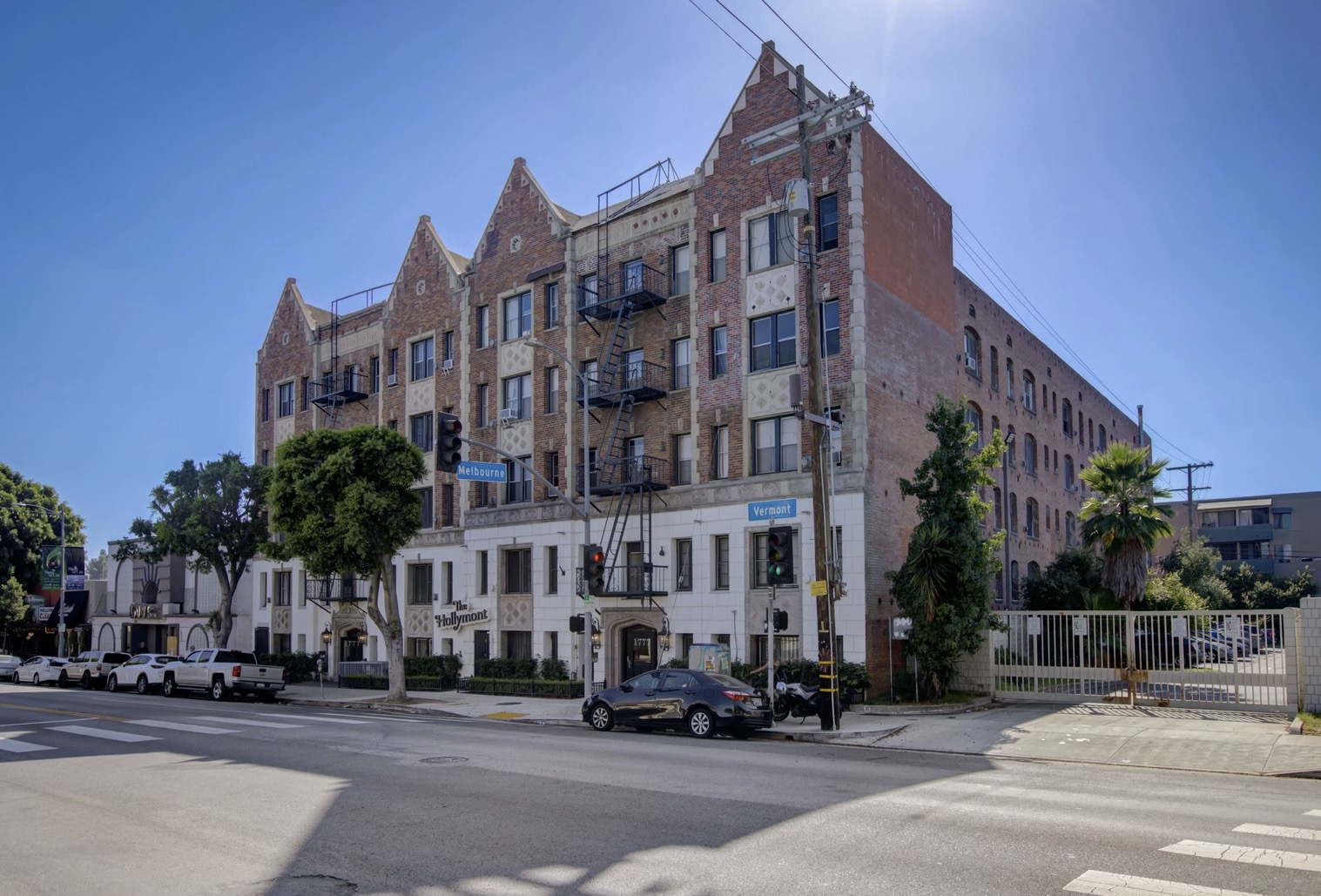
A flyer went up on Vermont Ave. The headline screams seven stories. The city’s own filing says six.
That one-story gap is the entire genre in miniature. Here’s what’s actually appealable — and what’s just noise.
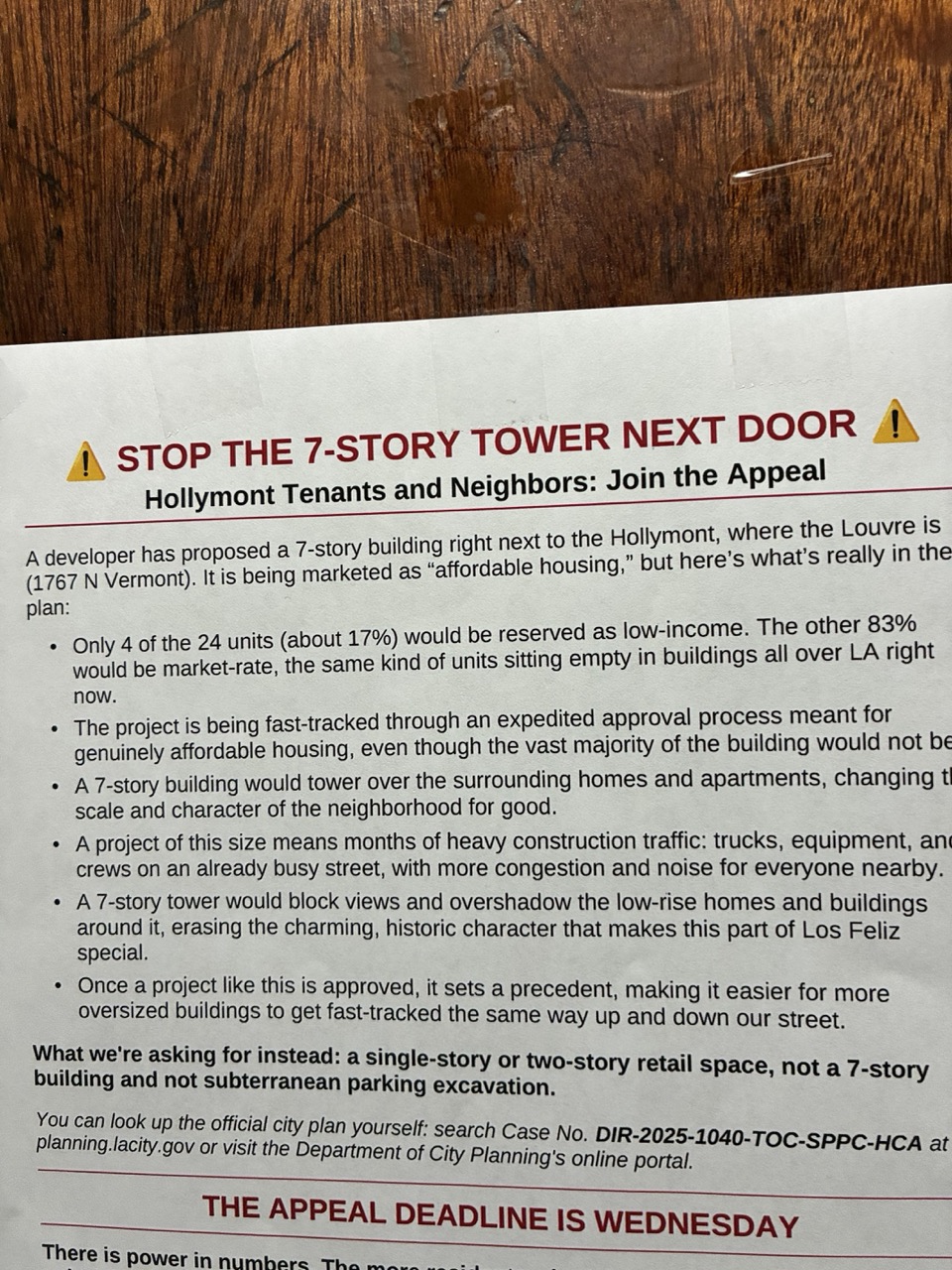
If you develop in Los Angeles long enough, you’ll meet this flyer. Yellow warning triangles. A number in the headline that’s been rounded up. A deadline in all caps. “Power in numbers.”
The latest rallying call from “the Resistance” surfaced next to the Hollymont. The target: a proposed Transit Oriented Communities project on the parcel beside it — a demo of an existing commercial venue and a new 24-unit apartment building over subterranean parking, a third of a mile from the Vermont/Sunset station.
We’re not here to argue the merits of one building. We’re here because the flyer is a teaching document. Past the loose legal interpretation and the subjective “facts,” you can see a community that’s upset and confused. Unpacking the why behind that could take longer than the entitlements themselves — but a productive community-engagement process turns into lessons that help you build projects the neighborhood supports instead of fights.
Let’s run the claims.
The Claims vs. The Record
- “7-Story Tower”
- The filed plans say six stories over subterranean parking. A free story, added by adjective.
- “Only 17% Affordable”
- That set-aside is the price of the density bonus, not a loophole. Mixed-income is how TOC has always worked.
- “Fast-Tracked”
- A qualifying TOC project gets a ministerial path by design. That’s the program functioning, not a trick being pulled.
- “Sets A Precedent”
- The “precedent” is state law. It was set in Sacramento years ago — this parcel didn’t write it.
- “Scale & Character”
- A real feeling, but not an objective standard. Character isn’t a finding a decision-maker can hang a denial on.
- “Construction Traffic”
- Temporary, and managed at the haul-route and staging stage — not grounds to stop an entitlement.
Now, it’s easy to point at opposition and list everything they don’t understand. And frankly, on a by-right project you technically don’t even have to speak with them — but it wouldn’t be wise to brush off the experience of the local natives. A proper community meeting can flip enemies into allies and lead to solutions that are both profitable and amenable. A future project that’s welcomed carries intangible benefits your pro forma won’t calculate.
So while some union- or activist-backed groups may be acting in bad faith, most aren’t. They’re working from the only playbook anyone handed them — one written for a discretionary era that the state has spent a decade dismantling.
Which raises the only question that actually matters in an appeal:
What You Can Actually Fight. What’s A Lost Cause.
- Worth Your Energy
- Does the project actually meet TOC eligibility? Does it comply with the objective standards? Was the affordability tier calculated correctly? Are there real environmental-screening errors?
- A Lost Cause
- “It’s too tall.” “It blocks our views.” “It changes the character.” “We’d prefer a one-story shop.” “It sets a precedent.”
The first column is an appeal. The second is a feeling. A city can only act on the first — but you can learn plenty from the second.
Communities Fight When They Feel Blind-Sided
When the flyers go up and your inbox fills with “the neighbors are furious,” the instinct is to either panic or dig in. Both are mistakes.
The move is to separate the signal from the noise — out loud, in the room. Some concerns on that flyer are legitimate and worth designing around: construction staging, parking spillover, how the ground floor meets the street, the rhythm of the façade against a 1920s block. Address those early and you defuse half the opposition while making a genuinely better building.
Say you’re planning a mixed-use ground floor and the community hates it — because you chose popular but tacky aluminum cladding for the frontage and three big chain food spots. They might tell you they don’t need more food; they need a market. Redesign a more traditional street-level façade, pull a single large grocer, and you’ve traded three tenants for one long-term, class-A anchor — plus a street-level campaign telling the whole neighborhood this might just be “a great place to live.”
The rest — the height panic, the “precedent,” the affordability math framed as a scandal — you don’t argue, and you don’t apologize for. You let the objective standards do the talking. A project that pencils against the code doesn’t need to win a popularity contest. It needs to be correct, and it needs someone who can prove it’s correct at every step.
Correct is the easy part. Proving it is what you hire for.
This Is Where We Come In
Whitestone runs entitlement through exactly this kind of friction. We tell you, on day one, which of the neighbors’ concerns are real design inputs and which are a lost cause dressed up in caps lock. We keep qualifying projects on the ministerial track they’re entitled to. And we sit in the stakeholder meetings so the conversation stays on the record — not the rumor.
A flyer is not a finding of fact. We make sure the decision-maker knows the difference.
Proof, on some of the hardest ground in the city:
SB 9 Two Unit Development, Venice
Venice Coastal, 90291 • Guban Architecture
The first approved SB 9 two-unit development in the Venice Specific Plan — a coastal overlay where almost nothing moves by-right, and where the opposition playbook is at its loudest. Knowing the path that avoids public hearings kept us clear of a scarlet letter, and a meticulous context analysis cleared it through a Coastal Development Permit. A genuine first, on some of the hardest ground in the city to entitle.
If there’s a flyer with your project’s address on it — or you’re underwriting a parcel and want to know what the opposition can and can’t actually do — that’s a five-minute conversation that saves a six-month one. You don’t hire us to push paper. You hire us to read the room.
We’ll tell you which column each objection lands in before you ever spend a dollar fighting it.
Talk soon, Jake & Team Whitestone